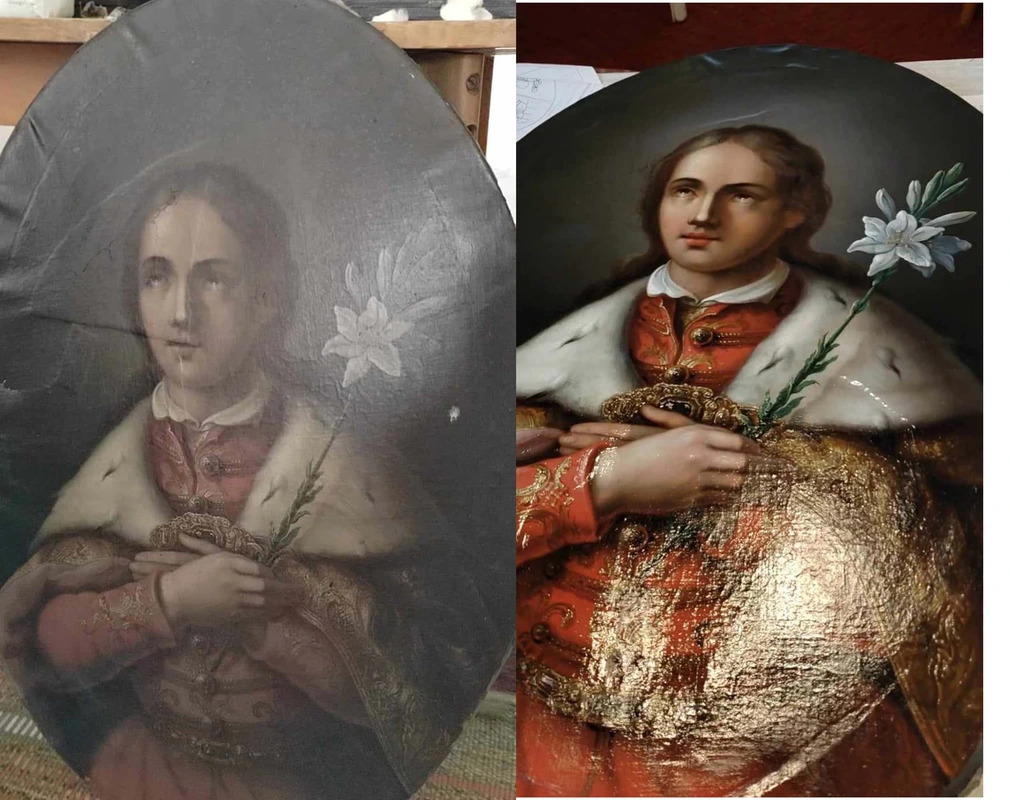
Restoration work

hjkhkhkhkhkjhk
Saving the mural under Ľupča Castle

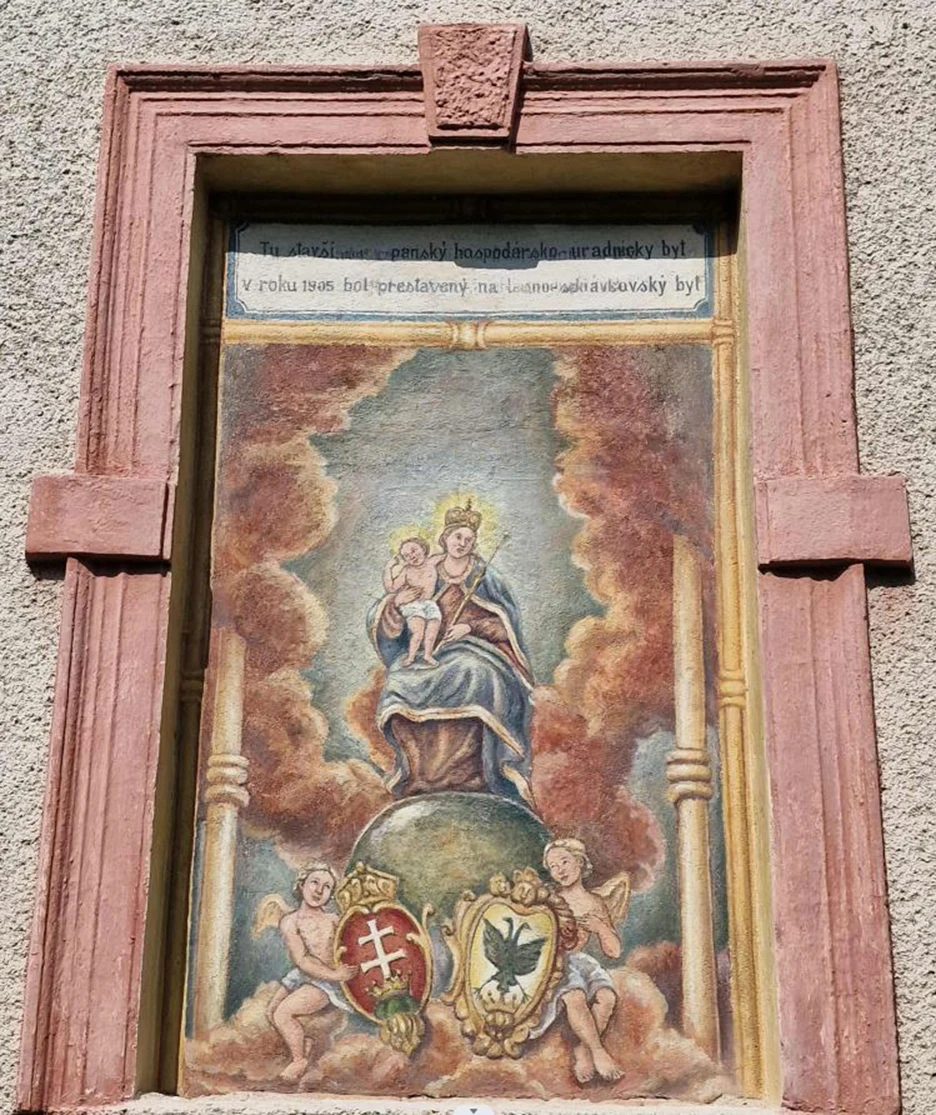
A historical work with exceptional iconography, associated with the Séči family, which decorates the facade of a historical building under Majer, managed to preserve a rare mural, which is a unique witness to the spiritual and cultural legacy of the 17th century nobility. Historical context In Jurkovich's work Zvolenská Ľupča history of the castle and manor, we find a detailed black and white reproduction of the painting, accompanied by the description: The image of the Virgin Mary donated by the Séči family. On the following page is a brief description: From the Séči period, a mural on the outer wall of the officer's apartment under the castle has also been preserved, which depicts the Virgin Mary with a child, and at her feet the Hungarian emblem and coat of arms of the Séči family. From the above, it clearly follows that this is a unique visual evidence of the patronage of the Séči family, characteristic of the nobility of the 17th century. This form of connection of religion, state power and gender identity was manifested in this case in the form of a monumental work on a building under the Ľupča Castle. Its historical value goes beyond the history of the castle and the village itself, because it is also significant in the broader context of the history of the shaft and the administration of the castle estates. The work Virgin Mary, Help of Christians, with the Child Jesus was restored between May 5 and June 3, 2025, based on the order of the Administration of NAPANT Banská Bystrica, Slovenská Ľupča.

Kostrol_sv._Petra_a_Pavla_Jahodná-11
Church of St. Peter and Paul

The Roman Catholic Church of St. Peter and Paul in the village of Jahodná is originally a Baroque-Classicist single-nave building built in 1748 - 1750. The donors of the church were the Esterházy family. Basic information and history: Architecture: The church is a single-nave building with a semicircular altar closure and a built-in tower, vaulted with Prussian vaults. The facades are divided by a lisén frame. Construction and consecration: It was built in 1748 to 1750 and was consecrated to the apostles St. Peter and Paul according to the day of consecration. Fire: In 1877, the village was hit by a large fire that destroyed the roof of the church, the tower and the organ, and damaged the bells. Renovations: The church underwent renovations after a fire in 1882 and later after World War II, when it was also re-facaded. Oldest building: It is considered the oldest public building in the village. Parish: It is the parish church of the Jahodná parish, which belongs to the Dunajská Streda deanery and the Trnava Archdiocese.

Staré_hory-2
Staré hory

Staré Hory is a Marian pilgrimage site with a rich tradition. More than five centuries filled with love and respect for the Mother of God. From an originally small mining settlement, it is now an internationally recognized Marian pilgrimage site, which welcomes thousands of pilgrims not only from Slovakia but also from Slovakia every year. The Staré Hory church with the gracious statue of the Virgin Mary and the well bring spiritual encouragement and purification from sins to believers and non-believers. Pilgrims came to Staré Hory as early as the 15th century. The important tradition of cleansing from sins through the sacrament of penance and in the spirit of the idea "Per Mariam ad Jesum" persisted in the following centuries. At the request of the Bishop of Bystrica, František Berchtold, Pope Pius VI was persuaded to grant Staré Hory a special privilege in 1780. This privilege was a visit to the Stará Hora church, combined with holy confession, holy communion and prayer, rewarded with full indulgences. An integral part of the pilgrimage site is Studnička. At this place, the inhabitants of Stará Hora hid a statue of the Virgin Mary during civil unrest in the 17th century. In 1711, it was dug up and brought to the altar in a ceremonial procession. In memory of its hiding, an image of the Virgin Mary was hung on the site. In the 19th century, the Studnička spring brought healing to the then parish priest Matej Hrivňák, who, out of gratitude, had a dignified stand made for the Madonna and at the same time the road to the well was also improved. On June 28, 1942, this precious place, as well as the new statue of the Virgin Mary, was solemnly consecrated by the Banská Bystrica bishop Andrej Škrábik. In 1990, the Stará Hora Church of the Visitation of the Virgin Mary was awarded the title of Minor Basilica. About 12,000 pilgrims attended this important event, which was accompanied by a pontifical mass celebrated by Bishop Rudolf Baláž, Bishop Emeritus Jozef Feranc,…

01KCCFATCYFMT6DW3JTPJH6VNF
Roman Catholic Church Rabča

The parish of Rabča is located in the Námestovský deanery of the Spiš bishopric. It is mentioned in 1564 in the tax lists of the Orava estate. However, it is already marked as existing on a manuscript map from 1550. Since 1656, Rabča belonged to the Rabčica parish, before that to the Trsteno parish. In 1658, the people of Rab built a small church in their village and in 1711 they built a new one, since the original one was no longer suitable. In 1771, the parish building was built and in 1772 the parish was established. The parish church is dedicated to the Visitation of the Virgin Mary.

Kaštieľ_Dolná_Krupa-7
Dolna Krupa Manor House

Krupá Manor, a unique work of classicist rural architecture in Slovakia, was the residence of the Brunsvik family - later (after the praslice) Chotek. In the past, the manor hosted the Hungarian and European elite. The prominent artist Ludwig van Beethoven also stayed here, who taught the young ladies of the Brunsvik family how to play the piano. Perhaps the most prominent personality living in the manor is Mária Henrieta Choteková, also nicknamed the Pink Countess. The ambitious woman built the largest rose garden in Central Europe in the territory of Dolná Krupá. The manor's rose garden contains a variety of roses that the Countess herself bred and embellished to perfection. Dolná Krupá is the place where Ludwig van Beethoven (1770 - 1827) composed his most famous piano work - the Moonlight Sonata. The composer is said to have visited the Brunswick family mansion between 1800 and 1806. He dedicated several compositions to the Brunswicks and thanks to them he also met his lifelong love. During his stay in the mansion, he probably composed the famous Moonlight Sonata. The title page of this famous composition is dedicated to Giuletta Giucciardi, a relative of the Brunswick family, with whom Beethoven apparently fell in love. One legend claims that his "letter to an immortal lover" was also addressed to the mansion in Dolna Krupa, but he did not mention her name in it. Whether this was really the case remains a mystery to this day. However, the connection of the famous composer with Dolna Krupa is forever linked. Next to the mansion, there is a rococo Beethoven pavilion with an exhibition of music.

Rim._kat._kostol_Palúdzka-1
Rome. cat. church Palúdzka

Around the year 1300, nobleman Ondrej had a church dedicated to St. built in Palúdzka for his own use. John the Apostle. A little later, his relatives, landowners in Bodice, had the church of St. Ladislav built with the financial contribution of župan Donč. From the beginning, the church in Palúdzka only had the privilege of a cemetery chapel, subordinate to the parish priest in St. Mary. It became a parish church, according to data in older literature, in 1307. Later, a dispute arose over parish rights and powers over the villages of Kamenná Poruba and Pavčina Lehota between parish priest Peter in Palúdzka and parish priest in Bodice.

Rim._kat._kostol_sv._Alžbety-1
Rome. Catholic Church of St. Elizabeth

Church of St. Elizabeth in B. Bystrica was built in 1303 as part of the city hospital. It was a smaller early Gothic building with a polygonal presbytery. Around the middle of the 15th century, they covered it with a cross rib vault, whose buttresses with chalice capitals are stylistically close to the one in the church in Slovenská Ľupča. In 1605, the entire hospital and the church burned down, which led to significant reconstruction in 1748. At that time, they built an essentially new one-nave church with an oval-ended presbytery oriented in the north-south direction. The polygonal sanctuary, the sacristy and the northern wall of the nave were used from the Gothic building. The sanctuary became a side chapel dedicated, after the new one, to St. Anne. The church acquired its current form in 1877 during the neo-Gothic reconstruction, which, among other things, created a new facade with two windows on the sides of the new entrance. Apart from the rough construction of the presbytery and its vault, the triumphal arch and one window with an arched arch have been preserved from the medieval building. Currently, the church is managed by the Missionary Society of St. Vincent de Paul.

1 - 7 of 7 projects

Reštaurovanie | Soli Deo honor et gloria - ad maiorem Dei gloriam